
Beggar with a Wooden Leg
c. 1625 - c. 1700
Medium
boxwood
Dimensions
13.1; 5.5; 12.5; 3.5
Rights
Public Domain
About this artwork
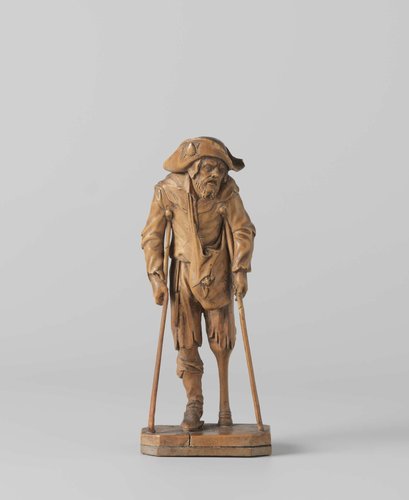
Hij staat op het rechterbeen en leunt op twee krukken; het pijnlijk vertrokken gelaat is naar rechts gewend. Over een kapje draagt hij een grote pelgrimshoed, waarvan de opgeslagen rand een schelp tegen twee kruiselings geplaatste pijlen vertoont. Zijn haveloze, niet geheel definieerbare kleding bestaat o.a. uit een buis met gerafelde mouwen en dito broek. Aan het been zit een afgezakte kous en aan de voet een muil. Om zijn nek hangt een grote tas, waarvan de inhoud door een gat naar buiten stee...
Art Historical Context
### Beggar with a Wooden Leg This poignant small-scale sculpture, carved from boxwood around 1625–1700 by an anonymous artist, captures the hardships of a one-legged beggar leaning on two crutches. Standing just 12.5 cm tall, 5.5 cm wide, and about 3.5 cm deep, the figure turns his painfully contorted face to the right, evoking empathy through its expressive detail. He wears a large pilgrim's hat with an upturned brim displaying a scallop shell against two crossed arrows—a nod to pilgrimage traditions, possibly linked to the Camino de Santiago. His ragged attire includes a frayed doublet and trousers, a slipped stocking, mule shoe, a bulging beggar's bag around his neck, and a belt with what may be a knife sheath, all rendered with remarkable precision in the dense, fine-grained wood. Boxwood, prized in 17th-century Northern Europe for its carvability, allowed artisans to achieve intricate textures like frayed fabric and weathered skin in compact forms. These anonymous carvings, likely from the Low Countries, reflect the era's fascination with genre scenes depicting everyday life, poverty, and wanderers amid the Baroque period's social contrasts. This work invites reflection on 17th-century realities: beggars and pilgrims were ubiquitous, symbolizing both spiritual quests and urban destitution. Its survival as a tactile, intimate object underscores the artistry of overlooked makers, offering visitors a window into humanity's enduring struggles.