
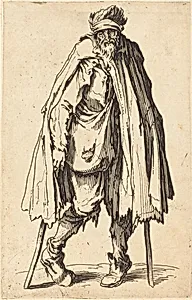
Beggar with Crutches and Sack
c. 1622
Medium
etching on laid paper
Dimensions
sheet (trimmed to plate mark): 14 × 9 cm (5 1/2 × 3 9/16 in.)
Classification
Department
CG-E
Museum
National Gallery of Art, Washington, D.C.
Credit
R.L. Baumfeld Collection
Accession Number
1969.15.501
Rights
Public Domain
Art Historical Context
Jacques Callot's *Beggar with Crutches and Sack* (c. 1622) is a poignant etching on laid paper, measuring just 14 × 9 cm, captured with exquisite precision. This intimate print from the National Gallery of Art's.L. Baumfeld Collection a ragged figure leaning on crutches, burdened by a sack, embodying the harsh realities of 17th European underclass life. Callot, a masterful French printmaker of the Baroque era, produced this as part of his renowned *Beggars* (*Les Gueux*) series, using etching—a technique where acid etches intricate lines into a metal plate—to create richly detailed images from a single plate. Callot's innovative etching style allowed for unprecedented finesse, with thousands of fine lines per square inch that convey texture, movement, and emotion in miniature scale. These small prints were highly collectible, revolutionizing printmaking by blending documentary realism with dramatic flair. During the tumultuous Thirty Years' War, Callot's works offered a unflinching yet empathetic glimpse into social margins, highlighting poverty and human resilience. This piece invites visitors to ponder the artist's social commentary, reminding us how art can humanize the forgotten. A testament to Callot's genius, it remains a highlight of graphic arts history.
About the Artist
Jacques Callot · 1592–1635
Jacques Callot (1592–1635) was a French printmaker and draftsman from the Duchy of Lorraine, widely regarded as one of the first great artists to practice the graphic arts exclusively. His more than 1,400 etchings chronicled the breadth of 17th-century life, from Medici court festivities to the brutal realities of warfare. Callot revolutionized etching through technical innovations including the é...