
Beggars at a Doorway
Medium
Oil on canvas
Dimensions
20 1/4 x 23 3/8 in. (51.4 x 59.4 cm)
Classification
Paintings
Department
European Paintings
Museum
Metropolitan Museum of Art, New York, NY
Credit
Purchase, 1871
Accession Number
71.80
Rights
Public Domain
Tags
Art Historical Context
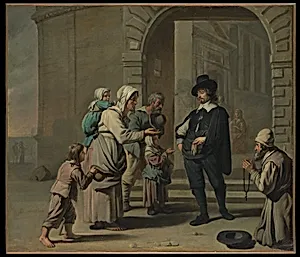
"Beggars at a Doorway" captures a poignant moment of everyday life in 17th-century Europe. Attributed to the Master of the Béguins—an artist active between 1650 and 1660, possibly the Flemish painter Abraham Willemsens—the work portrays a group of men, women, and children gathered at a threshold. The scene reflects the period’s growing interest in genre paintings that observed ordinary people with dignity and compassion. Painted in oil on canvas, the modest-sized work (roughly 20 by 23 inches) allows for intimate viewing. The medium’s rich textures and subtle tonal shifts help convey the varied fabrics of clothing and the play of light across faces, drawing viewers into the quiet exchange at the door. Such compositions often invited reflection on charity and social conditions without overt drama. Acquired by the Metropolitan Museum in 1871, the painting remains a compelling example of mid-17th-century Northern European realism. Its focus on humble figures continues to resonate, reminding visitors of art’s long tradition of noticing those on society’s margins.
About the Artist
Master of the Béguins, French or Flemish, active 1650–60 (possibly Abraham Willemsens, Flemish, active by 1627, died 1672) · 1627–1672
**The Master of the Béguins (possibly Abraham Willemsens) was a Flemish painter active in the mid-17th century, renowned for intimate genre scenes that blend everyday life with subtle religious or social undertones.** Often working in or near Paris between roughly 1650 and 1670, the artist earned the notname “Master of the Béguins” from recurring depictions of beguine nuns and peasant subjects ren...