
Bell
Unknown Artist
12th century
Medium
Bronze
Dimensions
Overall: 3 x 3 3/4 in. (7.6 x 9.5 cm)
Classification
Metalwork-Bronze
Culture
French
Department
The Cloisters
Museum
Metropolitan Museum of Art, New York, NY
Credit
The Cloisters Collection, 1925
Accession Number
25.120.448
Rights
Public Domain
Tags
Art Historical Context
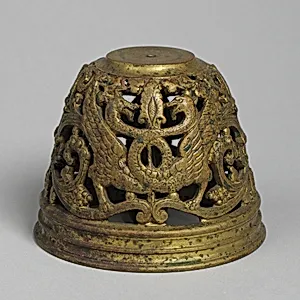
This exquisite 12th-century bronze, crafted by an unknown French artist, exemplifies the refined metalwork of medieval Europe. Measuring just 3 x 3 3/4 inches, its compact form suggests it was likely used in a monastic or ecclesiastical setting—perhaps to summon worshippers to prayer or mark daily rituals in a cloister or chapel. Housed in The Cloisters at the Metropolitan Museum of Art since 1925, it the era's deep integration of art and spirituality. Bronze, valued for its durability and resonant tone, was cast using sophisticated lost-wax techniques, allowing intricate details like the griffins adorning its surface. These mythical beasts—half-lion, half-eagle—symbolized divine protection and vigilance in Romanesque art, warding off evil and guarding sacred spaces. Such motifs underscore the bell's role not just as a functional object, but as a talisman blending Christian iconography with ancient lore. As a survivor from France's vibrant medieval workshops, this bell offers a tangible link to the sensory world of the Middle Ages, where sound and symbolism intertwined to elevate the divine.