
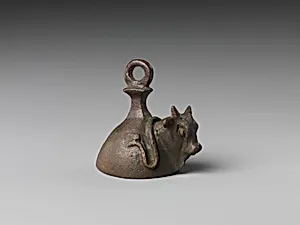
Bell with head of a bovine wearing a yoke ending in uraei
Unknown Artist
332–30 B.C.
Medium
Leaded bronze
Dimensions
H. 4.4 × W. 3.2 × D. 4.5 cm (1 11/16 × 1 1/4 × 1 3/4 in.)
Classification
Music, bell, bovine head, uraeus
Period
Ptolemaic Period
Department
Egyptian Art
Museum
Metropolitan Museum of Art, New York, NY
Credit
Gift of Lily S. Place, 1923
Accession Number
23.6.33
Rights
Public Domain
Tags
Art Historical Context
This exquisite leaded bronze bell from Egypt's Ptolemaic Period332–30 B.C.) features the detailed head of a bovine—likely a cow or bulladorned with a yoke that terminates in rearing uraei, the sacred cobras symbolizing protection and royal power. Crafted during the era of Greek rulers like the Ptolemies, who blended Hellenistic influences with deep Egyptian traditions, this small (just 4.4 cm high) exemplifies the cultural syncretism of the time. Bovines held profound religious significance in ancient Egypt, evoking deities like Hathor, the goddess of love and fertility, or the sacred Apis bull. The bell's intricate design highlights advanced bronze-casting techniques, where lead was added to the alloy for easier molding and a richer patina. Uraei on the yoke underscore themes of divine safeguarding, suggesting it may have served as a ritual object, amulet, or part of a larger ceremonial ensemble—rung to invoke protection or during processions. Its diminutive size made it portable, ideal for personal devotion amid the Ptolemaic blend of everyday piety and grandeur. Now at the Metropolitan Museum of Art, thanks to a 1923 gift from Lily S. Place, this piece offers a window into Ptolemaic artistry: precise, symbolic, and enduring. Visitors, imagine the soft chime echoing ancient prayers!