
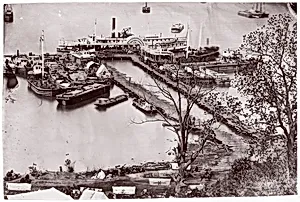
Belle Plain, Virginia
Medium
Albumen silver print from glass negative
Classification
Photographs
Department
Photographs
Museum
Metropolitan Museum of Art, New York, NY
Credit
Harris Brisbane Dick Fund, 1933
Accession Number
33.65.25
Rights
Public Domain
Tags
Art Historical Context
Captured in 1864 amid the American Civil War,Belle Plain, Virginia* is a poignant albumen silver print from glass negative, attributed to photographers James Gardner, Timothy H O'Sullivan, and Mathew. Brady's studio. image depicts the bustling docks at Belle Plain, a key Union supply base on theahannock River, with boats laden with troops, equipment, and provisions. O'Sullivan, a master of wartime documentation under Brady's famed studio, and Gardner brought the raw logistics of war to light, offering viewers a glimpse into the vital waterways that sustained the Northern effort. The photograph's historical significance lies in its unvarnished portrayal of the Civil War's behind-the-scenes machinery. Belle Plain served as a massive embarkation point during Ulysses S. Grant's Overland Campaign, handling hundreds of thousands of soldiers and vast supplies. Unlike dramatic battle scenes, this work highlights the quieter heroism of supply lines, underscoring how victory depended on such unglamorous operations. Technically, the albumen process—using egg whites to bind silver salts on paper—produced sharp, richly toned images from large glass negatives, revolutionizing 19th-century photography. Donated to The Metropolitan Museum of Art via the Harris Brisbane Dick Fund in 1933, this print preserves a pivotal moment, inviting us to reflect on war's profound human and material toll.