
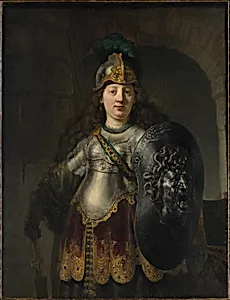
Bellona
Medium
Oil on canvas
Dimensions
50 x 38 3/8 in. (127 x 97.5 cm)
Classification
Paintings
Department
European Paintings
Museum
Metropolitan Museum of Art, New York, NY
Credit
The Friedsam Collection, Bequest of Michael Friedsam, 1931
Accession Number
32.100.23
Rights
Public Domain
Tags
Art Historical Context
Step into the fierce presence of *Bellona*, a commanding 1633 oil on canvas by Rembrandt van Rijn, housed in the Metropolitan Museum Art's European Paintings department This monumental work (50 x 38 3/8 inches) portrays Bellona, the Roman goddess war, clad in ornate armor that gleams with metallic realism. Rembrandt captures her as a powerful female figure, embodying strength and divinity through her poised stance and intense gaze. Painted during Rembrandt's early maturity in Amsterdam, when he was rising as a master of the Dutch Golden Age, *Bellona* reflects his fascination with classical mythology and history painting. The Baroque style shines through his virtuoso use of chiaroscuro—bold contrasts of light and shadow—that sculpts the armor's intricate textures and drapery, drawing viewers into a theatrical drama. Oil on canvas allowed Rembrandt to layer glazes for luminous depth, a technique that revolutionized portraiture and narrative scenes. As part of The Friedsam Collection, this piece highlights Rembrandt's ability to infuse mythological subjects with human emotion and technical brilliance, making ancient gods feel vividly alive. A testament to 17th-century artistic innovation, *Bellona* invites us to ponder war's dual nature—glorious yet formidable—through one of history's greatest lenses.
About the Artist
Rembrandt (Rembrandt van Rijn) · 1606–1669
Rembrandt Harmenszoon van Rijn (1606–1669) stands as one of the greatest visual artists in the history of Western art and the most important Dutch painter of the 17th century. Born in Leiden to a prosperous miller's family, Rembrandt transformed painting through his revolutionary use of light and shadow, his psychological depth in portraiture, and his elevation of etching to a fine art. His approx...