
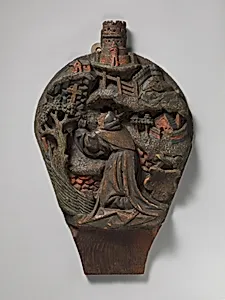
Bellows with Relief
Unknown Artist
early 16th century
Medium
Oak, polychromy, gilt
Dimensions
Overall: 12 3/8 x 7 7/8 x 1 5/16 in. (31.5 x 20 x 3.4 cm)
Classification
Sculpture-Miniature-Wood
Culture
North French (?)
Department
Medieval Art
Museum
Metropolitan Museum of Art, New York, NY
Credit
Gift of J. Pierpont Morgan, 1916
Accession Number
16.32.307
Rights
Public Domain
Art Historical Context
This exquisite *Bellows with Relief*, crafted in the early 16th century, hails from North France—or possibly nearby regions—and exemplifies the artistry of everyday objects in late medieval and early Renaissance Europe. Carved from oak into a compact panel measuring just 12⅜ × 7⅞ × 1⁵/₁₆ inches, it once adorned a blacksmith's bellows, the leather air-pumping device essential for forges. The low-relief sculpture, likely depicting a religious or narrative scene, transforms a utilitarian tool into a decorative masterpiece, blending functionality with piety. The medium—polychrome-painted and gilt oak—highlights masterful techniques of the period. Artisans applied vibrant colors and gold leaf to mimic luxurious stone or ivory, enhancing the wood's natural grain while protecting it from wear. This miniature wood sculpture, now in the Metropolitan Museum of Art's Medieval Art Department (gift of J. Pierpont Morgan, 1916), reveals how Northern French workshops elevated humble items with intricate carving, bridging Gothic traditions and emerging Renaissance realism. Such artifacts offer a glimpse into daily life: imagine a smith pausing to admire this glowing panel amid the heat of the forge. Its survival underscores the era's fusion of craft and devotion, inviting us to appreciate the unseen beauty in the ordinary.