
Bells, Probably for a Horse Harness
Unknown Artist
ca. 3rd century
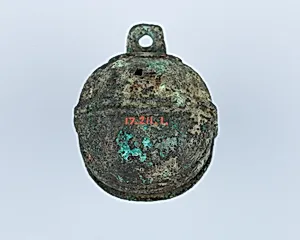
Medium
Bronze
Dimensions
17.211.1: H. 2 3/8 in. (6 cm); Diam. 1 7/8 in. (4.8 cm); Wt. 3.7 oz. (104.9 g); 17.211.2: H. 2 1/8 in. (5.4 cm); Diam. 1 3/4 in. (4.4 cm); Wt. 2.7 oz. (76.5 g)
Classification
Miscellaneous-Buckles & Ornament
Culture
Japanese
Department
Arms and Armor
Museum
Metropolitan Museum of Art, New York, NY
Credit
Gift of a Trustee of the Museum, 1917
Accession Number
17.211.1–.2
Rights
Public Domain
Art Historical Context
Nestled in the Metropolitan Museum of Art's Arms and Armor department, these delicate bronze bells—likely from a horse harness—date to around the 3rd century, a pivotal time in early Japanese history. Crafted by an unknown artisan, the pair consists of two small bells (cataloged as 17.211.1 and 17.211.2 each standing just over 2 inches high with diameters under 2 inches and weights around 3 ounces. Donated as a gift from a museum trustee in 1917, they exemplify the exquisite metalwork of Japan's Yayoi-to-Kofun transition period, when continental influences from Korea and China introduced horses to the archipelago. Bronze, a prized medium symbolizing technological prowess, was cast using sophisticated lost-wax or sectional molding techniques, allowing for intricate details that would produce a clear, resonant jingle as horses moved. These bells weren't mere decoration; they adorned elite harnesses, signaling status, warding off evil spirits, or enhancing the spectacle of processions and early warfare. In a culture where horses represented power and mobility—newly adopted for transport, farming, and combat—they highlight Japan's growing connections with Eurasian steppe traditions. Fun fact: Imagine the rhythmic chime echoing across ancient Japanese plains, turning a rider's approach into an auditory announcement of arrival. Though classified as buckles and ornaments, these bells bridge the worlds of utility and artistry, offering a tangible glimpse into a warrior society's emerging equestrian elegance.