
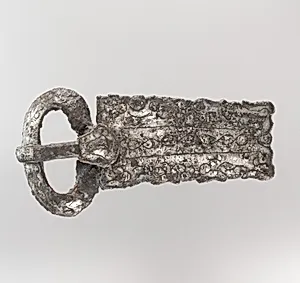
Belt Buckle
Unknown Artist
7th century
Medium
Iron, silver inlay, copper alloy
Dimensions
Overall: 6 1/8 x 3 1/16 x 1 in. (15.5 x 7.8 x 2.5 cm)
Classification
Metalwork-Iron
Culture
Frankish or Burgundian
Department
Medieval Art
Museum
Metropolitan Museum of Art, New York, NY
Credit
Gift of J. Pierpont Morgan, 1917
Accession Number
17.191.336
Rights
Public Domain
Art Historical Context
This exquisite 7th-century belt buckle, crafted from iron with intricate silver inlay and copper alloy, hails from Frankish or Burgundian during the early Medieval period. Measuring just 6 1/8 x 3 1/16 x 1 inches, it exemplifies the fine metalwork of Germanic tribes who dominated post-Roman Europe. Belts buckles like this were more than functional; they served as status symbols warriors and elites, often buried with their owners to signify wealth and prowess in the afterlife. The buckle's artistic significance lies in its sophisticated techniques, including silver inlays that create contrasting patterns against the iron base—a method akin to damascening, blending practicality with decoration. This reflects the fusion of Roman metallurgical traditions with Germanic innovation, highlighting cultural exchanges across early medieval Europe amid the Merovingian Frankish kingdoms. Housed in the Metropolitan Museum of Art's Medieval Art department as a gift from J. Pierpont Morgan in 1917, this piece offers a tangible glimpse into a turbulent era of migration, conquest, and emerging Christian influences, reminding us of the skilled artisans who adorned everyday life with quiet splendor.