
Belt Buckle
Unknown Artist
mid-500s
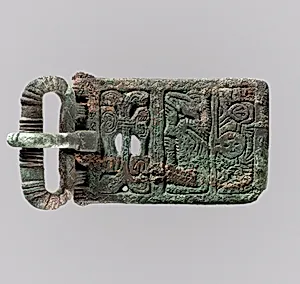
Medium
Copper alloy, tinned surface
Dimensions
Overall: 3 9/16 x 1 7/8 x 11/16 in. (9.1 x 4.7 x 1.8 cm)
Classification
Metalwork-Copper
Culture
Frankish
Department
Medieval Art
Museum
Metropolitan Museum of Art, New York, NY
Credit
Gift of J. Pierpont Morgan, 1917
Accession Number
17.193.129
Rights
Public Domain
Art Historical Context
This exquisite Frankish belt buckle, dating to the mid-500s, hails from the early Merovingian period when the Franks—a Germanic people—dominated much of western Europe, laying the foundations for medieval France and Germany. Crafted from copper alloy with a tinned surface that mimics the luster of silver, it measures a compact 3 9/16 x 1 7/8 x 11/16, perfect for securing a warrior's or noble's belt. Such accessories were more than functional; they symbolized status and wealth in a turbulent era of migrations and conquests. The tinned finish highlights sophisticated metalworking techniques of the time, where artisans applied a thin layer of tin through heating or dipping to enhance durability and shine, making affordable copper rival precious metals. As a prime example of Frankish metalwork, it reflects the blend of Roman influences and Germanic motifs in early medieval art, showcasing intricate designs that likely featured zoomorphic or geometric patterns typical of the period. Generously gifted to the Metropolitan Museum of Art by J. Pierpont Morgan in 1917, this buckle offers a tangible glimpse into daily life among the Franks, bridging the gap between late antiquity and the Middle Ages. Visitors, imagine fastening it at your waist amid the clamor of 6th-century Gaul!