
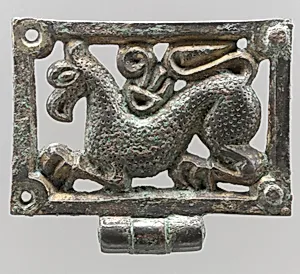
Belt Mount
Unknown Artist
8th century
Medium
Copper alloy, gilt
Dimensions
Overall: 1 7/8 x 1 9/16 x 1/4 in. (4.7 x 3.9 x 0.6 cm)
Classification
Metalwork-Copper
Culture
Avar
Department
Medieval Art
Museum
Metropolitan Museum of Art, New York, NY
Credit
Rogers Fund, 1952
Accession Number
52.51.2
Rights
Public Domain
Tags
Art Historical Context
This exquisite belt mount from the 8th century showcases the masterful metalwork of the Avar, a nomadic people who dominated the Carpathian Basin in Central Europe during the early Middle Ages. Crafted from copper alloy and adorned with gilding—a technique that applies a thin of gold to enhance shine and prestige—the small piece (just under 2 inches wide) likely fastened a warrior's belt, symbolizing status and protection. Its intricate design features griffins, mythical creatures with the body of a lion and head of an eagle, a motif blending Eurasian steppe traditions with influences from Byzantine and Sasanian art. Avars were skilled horsemen and metal artisans, whose artifacts often appear in elite burials, reflecting a society of fierce raiders and traders. This mount exemplifies their zoomorphic style, where animals embodied power and otherworldly strength, warding off evil or asserting dominance. The gilding not only elevated its luxury but also highlighted the technical prowess in casting and chasing fine details on such a delicate scale. Today, housed in the Metropolitan Museum of Art's Medieval Art department (acquired via the Rogers Fund in 1952), this belt mount offers a glimpse into Avar life before their decline in the 9th century, bridging the gap between Migration Period turbulence and Carolingian Europe. A testament to forgotten craftsmanship!