
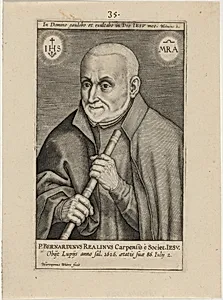
Bernardin Realinus, Jesuit Priest
1551 to 1600
Medium
engraving
Dimensions
plate: 12.4 × 7.5 cm (4 7/8 × 2 15/16 in.)
Classification
Department
CG-E
Museum
National Gallery of Art, Washington, D.C.
Credit
Rosenwald Collection
Accession Number
1950.14.1024
Rights
Public Domain
Art Historical Context
Welcome to the National Gallery of, where we encounter *ardin Realinus, Jesuit*, a delicate engraving by artist Hieronymus Wierix (c. 1553–1619). Created between 1551 and 1600, this intimate portrait—measuring just 12. × 7.5 cm—captures the solemn visage of Realinus, a member of the Society of Jesus, amid the turbulent religious landscape of the late 16th century. The Jesuits, founded in 1540, were at the forefront of the Catholic-Reformation, championing education, missionary work, and artistic patronage to reaffirm faith against Protestant challenges. Wierix, part of Antwerp's renowned family of engravers, mastered the intaglio technique of engraving, incising fine lines into a copper plate with a burin to hold ink, then pressing paper against it for precise, richly toned impressions. This medium revolutionized image dissemination, allowing devotional portraits like this to reach wide audiences affordably—perfect for personal prayer books or clerical collections. The small scale invites close contemplation, highlighting Wierix's skill in rendering subtle textures, from the priest's robes to his expressive gaze. Housed in the Rosenwald Collection (Department CG-E), this print exemplifies how engravings fueled spiritual devotion and cultural identity during Europe's Reformation era. A testament to art's role in faith, it reminds us how a tiny image could inspire profound piety.
About the Artist
Hieronymus Wierix · 1553–1619
Flemish draftsman and copper engraver from Antwerp. He was the son of Anton Wierix I, and the brother of Johan Wierix and Anton Wierix II. His style is very similar to that of his brother, Johan, and their works are often confused, exacerbated by the fact that they signed their plates with similar initials: Hieronymus often signed HI.W. or HI.W.F. Comment on works: Draftsman; Engraver