
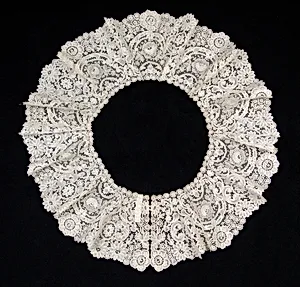
Bertha
Unknown Artist
ca. 1895
Medium
Linen
Classification
Bertha
Culture
Belgian
Department
Costume Institute
Museum
Metropolitan Museum of Art, New York, NY
Credit
Brooklyn Museum Costume Collection at The Metropolitan Museum of Art, Gift of the Brooklyn Museum, 2009; Gift of Jane Buck Hellawell, 1992
Accession Number
2009.300.6066
Rights
Public Domain
Art Historical Context
Step into the elegant world of late 19th-century fashion *Bertha*, a delicate linen piece from Belgium, created around 1895. Housed in the Metropolitan Museum of Art's Costume, this artwork exemplifies the refined textile traditions of its time. As a product of Belgian craftsmanship—renowned for intricate lace and fine linens—*Bertha* likely served as a collar or bodice trimming, a style that added graceful volume and ornamentation to women's dresses during the Belle Époque. Linen, its primary medium, was prized for its breathability and crisp texture, making it ideal for summer garments or underlayers in an era when elaborate silhouettes defined high fashion. By the 1890s, European designers were blending practicality with artistry, influenced by the Arts and Crafts movement's emphasis on natural materials. Though the artist remains unknown, the piece reflects Belgium's cultural prominence in textile innovation, bridging everyday wear and aesthetic refinement. Today, *Bertha* endures through the Brooklyn Museum Costume Collection, gifted to The Met in 2009 courtesy of Jane Buck Hellawell. It invites us to appreciate how clothing captured the era's social graces and technical mastery, offering a tangible link to the women who wore it.