
Betty Lamp
c. 1936
Medium
watercolor, graphite, and pen and ink on paper
Dimensions
overall: 35.3 x 24.9 cm (13 7/8 x 9 13/16 in.)
Classification
Index of American Design
Department
CG-W
Museum
National Gallery of Art, Washington, D.C.
Credit
Index of American Design
Accession Number
1943.8.12355
Rights
Public Domain
Art Historical Context
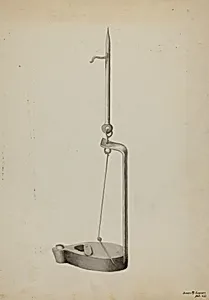
Behold the *Betty Lamp*, a meticulously rendered watercolor, graphite, and pen-and-ink depiction by James M. Lawson, around 1936. Measuring 35.3 x 24.9 cm, this work captures the humble yet essential form of a classic colonial-era oil lamp, prized for its simple, functional design. Lawson's precise lines and subtle washes evoke the lamp's weathered metal surfaces and practical contours, inviting viewers to appreciate everyday ingenuity from America's past. As part of the Index of American Design—a New Deal-era Federal Art Project (1935–1942)—this artwork exemplifies a national effort to document and celebrate American folk crafts amid the Great Depression. Artists like Lawson produced thousands of such detailed studies to preserve cultural heritage, ensuring that utilitarian objects like the Betty Lamp, a staple in 18th-century households for burning whale oil or fat, were not forgotten. Named possibly for its "Betty" reservoir or a folk tradition, these lamps symbolized self-reliance and thrift in early settler life. Lawson's mixed-media technique—combining ink's sharpness, graphite's subtlety, and watercolor's luminosity—mirrors the IAD's goal of scientific accuracy while infusing artistic warmth. Housed in the National Gallery of Art, it reminds us how ordinary tools shaped American identity, bridging craft and culture for generations.
About the Artist
James M. Lawson · 1855–present
James M. Lawson is an artist about whom the available historical record is limited. No confirmed birth or death dates have been established, and his nationality remains uncertain, making it difficult to place his work within a specific artistic movement or tradition with confidence. The works attributed to Lawson suggest a practitioner with artistic training and a developed approach to his chosen...