
Beurs van Londen
Medium
etching
Dimensions
396; 293
Rights
Public Domain
About this artwork
height 293 mm x width 396 mm
Art Historical Context
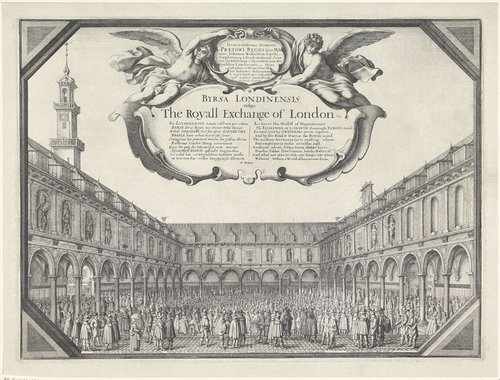
**Beurs van LondenView of the Royal Exchange, London)** *Wenceslaus Hollar, 1644, etching, 293 × 396 mm* Created in 1644 by the Bohemian etcher Wenceslaus Hollar,Beurs van Londen—Dutch for "London Exchange"—captures a panoramic view of London's Royal Exchange, a bustling hub of commerce designed by Sir Thomas Gresham in 1566. Hollar, who arrived in England in 1636 amid political turmoil, documented the city's architecture with remarkable precision during the English Civil War era. This etching preserves the Exchange's elegant courtyard and arcaded facade just decades before the Great Fire of 1666 destroyed much of historic London, offering invaluable historical testimony to 17th-century urban life. As a pioneering topographical artist, Hollar excelled in etching, a printmaking technique using acid to bite intricate lines into metal plates. His fine, delicate strokes render architectural details, figures, and atmospheric depth with lifelike clarity, blending documentary accuracy with artistic finesse. Belonging to the Baroque era's fascination with perspective and realism, this work highlights etching's rise as a medium for affordable, detailed reproductions, making grand cityscapes accessible to a wider audience. Today, *Beurs van Londen* stands as a cultural treasure, evoking the vibrancy of Stuart London and Hollar's enduring legacy as the "Bohemian Rembrandt." Visitors can appreciate how such prints bridged art and history, freezing a pivotal moment in time.
About the Artist
Wenceslaus Hollar · 1607–1677
Wenceslaus Hollar (1607-1677) was a prolific Bohemian etcher who became one of the most accomplished printmakers of the seventeenth century. Born in Prague, he trained under Matthäus Merian in Frankfurt before entering the service of Thomas Howard, Earl of Arundel, in 1636. Hollar spent most of his career in England, where he produced approximately 2,740 etchings documenting an extraordinary range...