
Bewoners van Sunda eilanden en zeeslag
1598
Medium
etching
Dimensions
290; 228
Rights
Public Domain
About this artwork
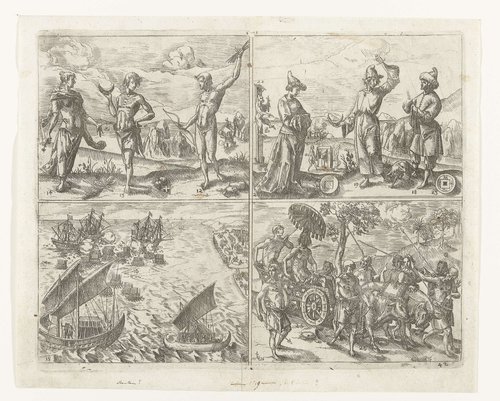
Blad met vier voorstellingen. Bovenaan links en rechts bewoners van de Sunda eilanden waaronder Sumatra en Java. Mannen en vrouwen in verschillende kleding poseren in landschappen. Daaronder links een zeeslag met grote schepen en kleine roeiboten aan de kust van de eilanden. Rechtsonder rijdt een mannelijke bewoner van de eilanden zittend op een kar getrokken door twee ossen en omringd door zijn bedienden. Bij de figuren staan nummers die lijken te verwijzen naar een toelichting
Art Historical Context
Adam Elsheimer’s 1598 etching *Bewoners van Sunda eilanden en zeeslag* offers a vivid window into Europe’s growing fascination with distant lands during the Age of Exploration. Created when the young German artist was just beginning his career, the print assembles four scenes on a single sheet: inhabitants of Sumatra and Java in varied costumes, a dramatic sea battle along the island coast, and a local man traveling by ox-drawn cart. Numbered figures suggest the work was designed as an educational illustration, likely accompanying travel accounts or maps that circulated among Dutch and German audiences eager for knowledge of Southeast Asia. Executed in the intimate scale of an etching (roughly 23 by 29 centimeters), the composition reflects Elsheimer’s early mastery of narrative grouping and delicate line work. Rather than a single dramatic moment, the sheet functions like a visual encyclopedia, blending ethnographic observation with scenes of conflict and daily life. Such prints played a crucial role in shaping European perceptions of the East Indies, translating written reports into accessible images that reached a wide public through the growing print market. Today the work stands as both an artistic and historical document, capturing the moment when artistic curiosity and colonial ambition began to intersect. Elsheimer’s sensitive rendering of costume and landscape helped transform distant places into vivid, if imagined, realities for viewers who would never sail beyond Europe’s shores.
About the Artist
Adam Elsheimer · 1578–1610
Elsheimer's meticulously detailed small paintings on copper would establish him as the most influential artist to follow Albrecht Dürer. He most likely arrived in Italy ca. 1598, where he quite possibly was associated with Hans Rottenhammer, and then moved to Rome in 1600, where he remained until his death. Comment on works: Landscapes; Religious.