
Bibi Lalouette
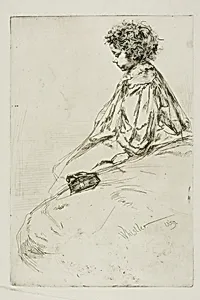
Medium
Etching and drypoint with foul biting in black ink on ivory laid paper
Dimensions
Plate: 22.2 × 15.1 cm (8 3/4 × 6 in.); Sheet: 34.5 × 24.5 cm (13 5/8 × 9 11/16 in.)
Classification
etching
Department
Prints and Drawings
Museum
Art Institute of Chicago
Accession Number
29439
Rights
Public Domain
Art Historical Context
In 1859, McNeill Whistler createdBibi Lalouette*, a striking etching and drypoint from his early career explorations in printmaking. This intimate portrait, executed in black ink on ivory laid, captures a moment of everyday French life during Whistler's time abroad, reflecting his fascination with Realism and the working-class subjects he encountered in Paris and beyond. Measuring a modest plate size of 22.2 × 15.1 cm, the work exemplifies Whistler's shift toward subtle, atmospheric effects, drawing inspiration from masters like Rembrandt while pushing etching toward modern impressionism. Whistler's technique here is masterful: etching uses acid to bite precise lines into a metal plate, while drypoint adds velvety burrs from direct needle scratches, creating rich tonal depth. The "foul biting"—unintended acid corrosion—lends a textured, organic quality, turning potential flaws into artistic virtues and highlighting his experimental approach. Part of the Art Institute of Chicago's Prints and Drawings collection, this piece belongs to Whistler's influential "French Set," showcasing his role in revitalizing etching as a fine art medium in the 19th century. Visitors will appreciate how *Bibi Lalouette* bridges portraiture and print innovation, inviting close inspection of its delicate lines and chance textures—a testament to Whistler's belief that art should evoke harmony and beauty over literal detail.
About the Artist
James McNeill Whistler · 1834–1903
James Abbott McNeill Whistler (1834-1903) was an American-born painter and printmaker who became a leading figure in the Aesthetic Movement and pioneer of Tonalism and Japonisme. He revolutionized art by championing "art for art's sake" and treating paintings as visual equivalents of musical compositions, titling works as "arrangements," "harmonies," and "nocturnes" to emphasize formal qualities o...