
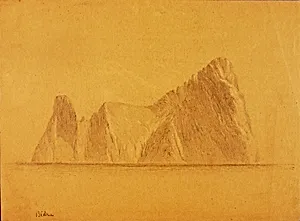
Bidra (possibly Bida?)
Medium
Drawing
Classification
Drawing
Department
Smithsonian Collection
Museum
Smithsonian American Art Museum
Credit
Smithsonian American Art Museum, Bequest of Martha F. Butler
Accession Number
1991.56.136
Rights
Public Domain
Tags
Art Historical Context
Miner Kilbourne Kellogg (1814–1889), a 19th-century American artist renowned for his portraits and landscapes, created *Bidra (possibly Bida?)*, an undated drawing that captures the dramatic interplay of coast and mountain. Active during a period when American artists drew inspiration from the Hudson River School's emphasis on sublime natural vistas, Kellogg often sketched during his travels abroad, blending meticulous observation with romantic idealism. This work, housed in the Smithsonian American Art Museum's collection through the bequest of Martha F. Butler, exemplifies his skill in rendering expansive scenery on paper. As a drawing, the piece highlights the medium's intimacy and immediacy—ideal for capturing fleeting coastal light and rugged peaks without the permanence of oil paint. The tags "coast" and "mountain" suggest a vista evoking nature's majesty, perhaps inspired by Kellogg's European or exploratory journeys, where he documented diverse terrains. Such sketches served both as studies for larger paintings and standalone evocations of place. Visitors to the Smithsonian will appreciate how *Bidra* reflects 19th-century wanderlust and the era's fascination with unspoiled landscapes, inviting contemplation of humanity's place amid towering cliffs and shimmering shores. (198 words)