
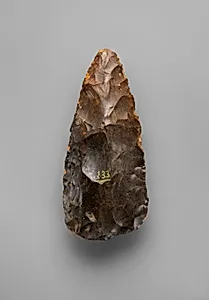
Biface
Unknown Artist
700,000–200,000 BCE
Medium
Flint
Dimensions
H. 9 1/2 in. (24 cm); W. 4 1/4 in. (10.8 cm); D. 1 5/8 in. (4.1 cm); Wt. 2 lb. 4 oz (1029 g)
Classification
Tools
Culture
Acheulean
Department
Arms and Armor
Museum
Metropolitan Museum of Art, New York, NY
Credit
Purchase, Arthur Ochs Sulzberger and Friends of Arms and Armor Gifts, Arthur Ochs Sulzberger Bequest, and funds from various donors, 2018
Accession Number
2018.51.2
Rights
Public Domain
Art Historical Context
Step back 300,000 to 700,000 years into the Paleolithic era with this remarkable flint biface, a hallmark of Acheulean culture. Crafted by an unknown artisan—likely early hominins such as Homo erectus—this handaxe exemplifies the sophisticated stone tool technology that defined human survival for hundreds of thousands of years. about 9½ inches long and weighing over two pounds, its robust, teardrop shape was meticulously flaked on both sides (hence "biface") from high-quality flint, creating sharp edges ideal for chopping wood, butchering animals, or processing plants. The Acheulean tradition, spanning Africa, Europe, and Asia, represents a technological leap from earlier Oldowan tools, with standardized, symmetrical forms showing growing cognitive skills and planning. This piece's careful knapping—striking precise flakes to refine its profile—highlights the "art" in prehistoric craftsmanship, blending utility with an emerging aesthetic symmetry. Though classified among arms and armor, it was primarily a versatile tool, underscoring how early humans blurred lines between making and wielding. Acquired by The Metropolitan Museum of Art in 2018 through generous gifts, this biface invites us to ponder our ancestors' ingenuity, bridging the gap between raw survival and cultural evolution. A tangible whisper from deep time!