
Bifolium from a Qur'an Manuscript
Unknown Artist
15th century
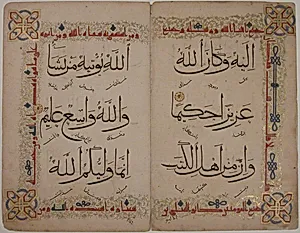
Medium
Ink, opaque watercolor, and gold on paper
Dimensions
H. 11 3/8 in. (28.9 cm) W. 14 5/8 in. (37.1 cm)
Classification
Codices
Department
Islamic Art
Museum
Metropolitan Museum of Art, New York, NY
Credit
Rogers Fund, 1962
Accession Number
62.152.8
Rights
Public Domain
Tags
Art Historical Context
This exquisite bifolium, or two facing pages, comes from a 15th-century'an manuscript, a sacred text central to Islamic faith. Crafted by an unknown artist during a golden age of Islamic book arts, it exemplifies the reverence for the written word in Muslim cultures. Housed in the Metropolitan Museum of Art Islamic Art Department (acquired through the Rogers Fund in 2), these pages measure 11 3/8 by 14 5/8 inches, typical for portable codices designed for personal devotion or study. The artistry shines through its medium of ink, opaque watercolor, and gold on paper. Calligraphic script, rendered in precise black ink, dominates the composition, with vibrant watercolors adding geometric and floral motifs. Gold leaf illuminates chapter headings and verse markers, creating a luminous effect that evokes divine light—a hallmark of Islamic illumination. This bifolium likely preserves surahs (chapters) from the Qur'an, showcasing the era's mastery of harmonious page layout. Culturally, such manuscripts highlight Islam's aniconic tradition, prioritizing abstract beauty and spiritual focus over imagery. Produced across regions like Persia, the Ottoman Empire, or North Africa, they were often commissioned by patrons for mosques or madrasas, blending piety with aesthetic splendor. Visitors, gaze closely at the intricate details—they whisper centuries of faith and craftsmanship.