
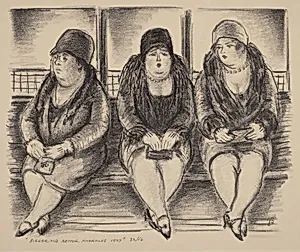
Bigger and Better Americans
1927
Medium
lithograph in black
Dimensions
image: 22.5 × 28 cm (8 7/8 × 11 in.) sheet: 29.2 × 39.7 cm (11 1/2 × 15 5/8 in.)
Classification
Department
CG-W
Museum
National Gallery of Art, Washington, D.C.
Credit
Reba and Dave Williams Collection, Gift of Reba and Dave Williams
Accession Number
2008.115.941
Rights
Public Domain
Art Historical Context
Julius Bloch's *Bigger and Better Americans (1927) is a striking black lithograph that captures the spirit of 1920s America through sharp social commentary. Born in Germany and arriving in the U.S. as a teenager, Bloch became a prominent figure in American printmaking and social realism, often depicting the lives of immigrants, workers, and everyday people. This modest-sized print—measuring 22.5 × 28 cm—exemplifies his keen eye for human character and cultural transformation during the Jazz Age. Lithography, the medium here, allowed Bloch to achieve rich tonal contrasts and fine details directly from stone or plate, making it an ideal choice for affordable, widely distributable art. In the 1920s, amid immigration quotas and booming national pride, the title evokes the era's boosterism and assimilation pressures, suggesting a wry take on newcomers striving to embody the "American dream." Bloch's precise lines and dramatic shading highlight themes of identity and progress, resonating with the print revival that democratized art for the masses. Housed in the National Gallery of Art's Reba and Dave Williams Collection, this work invites visitors to reflect on America's evolving melting pot. Its enduring appeal lies in Bloch's ability to blend empathy with satire, offering a window into the hopes and ironies of a transformative decade.