
Billiard Chair
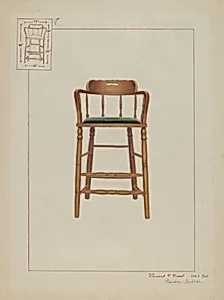
Medium
watercolor, colored pencil, pen and ink, gouache, and graphite on paper
Dimensions
overall: 30.4 x 22.8 cm (11 15/16 x 9 in.) Original IAD Object: 44"high overall; 19"wide. See data sheet for dets.
Classification
Index of American Design
Department
CG-W
Museum
National Gallery of Art, Washington, D.C.
Credit
Index of American Design
Accession Number
1943.8.4504
Rights
Public Domain
Art Historical Context
The *Billiard Chair*, rendered around 1937 by artists Vincent P. Rosel Gordon Saltar, captures the charm of an American furniture design in exquisite detail. This watercolor, colored pencil, pen and, gouache, and drawing on paper measures 30.4 x 22.8 cm and faithfully reproduces a chair standing 44 inches high and 19 inches wide. Part of the National Gallery of Art's collection, it showcases the functional elegance of billiard room seating—likely a low, sturdy piece designed for comfort during games of pool or billiards, evoking mid-19th-century American leisure culture. Created for the Index of American Design (IAD), a Works Progress Administration (WPA) project from 1935 to 1942, this artwork reflects the Great Depression-era effort to document and celebrate the nation's folk and decorative arts. Over 18,000 such renderings preserved everyday objects, promoting cultural heritage and national pride amid economic hardship. Rosel and Saltar's masterful use of mixed media—layering translucent watercolors with precise ink lines and opaque gouache—achieves a lifelike vibrancy, making the chair's form, wood grains, and upholstery leap off the page as if inviting visitors to a smoky parlor game. Today, this piece highlights how ordinary designs like the billiard chair embodied American ingenuity and social pastimes, bridging art history with everyday life. A delightful window into our creative legacy!