
Billingsgate
Medium
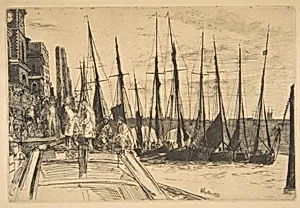
Etching and drypoint; nineth state of nine (Glasgow) ; black ink on medium weight buff laid paper
Dimensions
Plate: 6 × 8 13/16 in. (15.2 × 22.4 cm) Sheet: 8 1/16 × 10 9/16 in. (20.5 × 26.9 cm)
Classification
Prints
Department
Drawings and Prints
Museum
Metropolitan Museum of Art, New York, NY
Credit
Bequest of Julia H. Manges, in memory of her husband, Dr. Morris Manges, 1960
Accession Number
60.598.86
Rights
Public Domain
Tags
Art Historical Context
James McNeill Whistler’s *Billingsgate* (1859) captures the gritty vibrancy of London’s historic fish market along the Thames River. As part of Whistler’s “Thames Set” etchings, this print bustling human figures—fish porters, vendors, and workers—amid towering warehouses, ships, and the river’s edge. Created during a time of rapid industrialization in Victorian London, it reflects the artist’s fascination with the everyday poetry of urban life, blending realism with emerging impressionistic tendencies that would define his career. Rendered in etching and drypoint on buff laid paper, the ninth (and final) state showcases Whistler’s masterful technique. Etching provides crisp, fluid lines incised by acid, while drypoint’s direct needle scratches add velvety burrs for rich tonal depth and texture—evident in the shimmering water, shadowy figures, and architectural details. This state, as cataloged in the Glasgow edition, represents the print’s fullest expression, with intricate reworkings enhancing atmospheric mood over mere representation. Housed in the Metropolitan Museum of Art’s Drawings and Prints department (Bequest of Julia H. Manges, 1960), *Billingsgate* exemplifies Whistler’s influence on modern printmaking, prioritizing harmony and subtlety in the Aesthetic movement. Visitors are drawn to its lively snapshot of 19th-century London, a timeless tribute to the Thames’ enduring allure.
About the Artist
James McNeill Whistler · 1834–1903
James Abbott McNeill Whistler (1834-1903) was an American-born painter and printmaker who became a leading figure in the Aesthetic Movement and pioneer of Tonalism and Japonisme. He revolutionized art by championing "art for art's sake" and treating paintings as visual equivalents of musical compositions, titling works as "arrangements," "harmonies," and "nocturnes" to emphasize formal qualities o...