
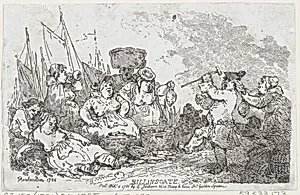
Billingsgate
February 4, 1786
Medium
Etching; a reissue
Dimensions
Sheet: 4 5/16 × 6 7/8 in. (11 × 17.4 cm)
Classification
Prints
Department
Drawings and Prints
Museum
Metropolitan Museum of Art, New York, NY
Credit
The Elisha Whittelsey Collection, The Elisha Whittelsey Fund, 1959
Accession Number
59.533.173
Rights
Public Domain
Tags
Art Historical Context
**Billingsgate** is a lively etching by the renowned British caricaturist Thomas Rowlandson published by Elizabeth Jackson on February 4, 1786. This reissue captures the chaotic energy of Billingsgate Market, London's bustling hub for seafood trade since medieval times. Through tags like satire, men, women,, and drinking, it humorously depicts the market's notorious fishwives—strong-willed porters haggling amid piles of fish, with hints of revelry and rowdiness. Rowlandson's wit skewers everyday urban life, reflecting 18th-century London's vibrant, often bawdy street culture. As a master of caricature, Rowlandson belonged to the golden age of British satire, alongside figures like Hogarth. His loose, expressive etching style—using acid to bite into metal plates—allowed for affordable, widely circulated prints that poked fun at social norms. This small sheet (4 5/16 × 6 7/8 in.) exemplifies how prints democratized art, bringing Rowlandson's observational humor to a broad audience beyond elite patrons. Housed in the Metropolitan Museum of Art's Drawings and Prints department through The Elisha Whittelsey Collection, **Billingsgate** offers a window into Georgian-era commerce and character. It's a delightful reminder of how markets like Billingsgate fueled both the economy and the imagination of artists. (198 words)
About the Artist
Thomas Rowlandson|Elizabeth Jackson · 1756–1827
Thomas Rowlandson (1757–1827) was an English artist and caricaturist whose satirical watercolors and prints captured the social life of Georgian Britain with unparalleled wit and technical mastery. Alongside James Gillray, he is recognized as one of the greatest British graphic artists, and his distinctive flowing line and keen observations have made his work integral to understanding late 18th an...