
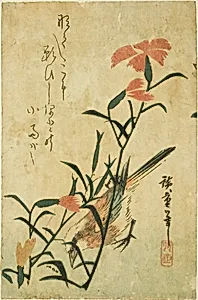
Bird and wild carnation
c. 1830s
Medium
Color woodblock print; yotsugiriban
Dimensions
19.1 × 12.6 cm (7 1/2 × 4 7/8 in.)
Classification
woodblock print
Department
Arts of Asia
Museum
Art Institute of Chicago
Accession Number
33661
Rights
Public Domain
Art Historical Context
Utagawa Hiroshige (1797–1858), one of Japan's most celebrated ukiyo-e masters, created *Bird and Wild Carnation* around the 1830s. This intimate color woodblock print exemplifies skill in *kachō-e*—depictions of birds and flowers—departing from his renowned landscapes like *The Fifty-three Stations of theōkaidō*. Rendered in the narrow *yotsugiriban* format (19.1 × 12.6 cm), it was likely produced as a luxurious *surimono* print for private patrons, showcasing refined elegance in a compact space. The print's historical significance lies in the Edo-period (1603–1868) ukiyo-e tradition, where woodblock printing democratized art amid Japan's urban flourishing. Hiroshige's delicate lines and vibrant colors, achieved through precise carving and layering of blocks, capture the wild carnation's textured petals and the bird's poised vitality, evoking nature's transient beauty—a core theme in Japanese aesthetics like *mono no aware* (the pathos of things). Housed in the Art Institute of Chicago's Arts of Asia department, this work highlights Hiroshige's versatility and the technical mastery of woodblock printing, where mica or embossing added subtle shimmer. Visitors will appreciate its poetic simplicity, inviting quiet contemplation of harmony between flora and fauna.
About the Artist
Utagawa Hiroshige · 1826–1869
Utagawa Hiroshige (1797–1858), born Andō Tokutarō, was the last great master of Japanese ukiyo-e woodblock printmaking and one of the most influential landscape artists in history. Born in Edo (modern Tokyo) into a low-ranking samurai family serving as fire wardens, Hiroshige transformed landscape printmaking into a poetic meditation on nature, weather, and everyday life. His revolutionary approac...