
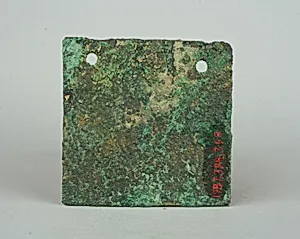
Bird Plaque Ornament
Unknown Artist
3rd century BCE–2nd century CE
Medium
Copper, gilt
Dimensions
H. 2 x W. 2 in. (5 x 5 cm)
Classification
Metal-Ornaments
Culture
Vicús
Department
Arts of Africa, Oceania, and the Americas
Museum
Metropolitan Museum of Art, New York, NY
Credit
Bequest of Jane Costello Goldberg, from the Collection of Arnold I. Goldberg, 1986
Accession Number
1987.394.395
Rights
Public Domain
Tags
Art Historical Context
This exquisite Bird Plaque Ornament crafted by an unknown Vicús artist between the 3rd century and 2nd century, exemplifies the masterful metalworking of ancient Peru's northern coast. Measuring just 2 x 2 inches (5 x 5 cm), this copper plaque, enhanced with gilding—a technique that applied a thin layer of gold to mimic the luster of solid precious metal—likely served as a decorative pin, ear ornament, or garment attachment. The bird motif, a recurring symbol in Vicús art, may evoke spiritual or natural themes central to their worldview, rendered with fine detail on the diminutive surface. Hailing from the Vicús culture (ca. 1000 BCE–200 CE), a sophisticated pre-Inca society known for innovative metallurgy and intricate designs, this piece highlights their skill in transforming humble copper into luxurious objects. Gilding not only elevated its aesthetic appeal but also signified status, bridging everyday adornment with elite artistry. Such ornaments were integral to personal and ritual expression in Vicús society, blending functionality with symbolism. Now housed in the Metropolitan Museum of Art's Department of the Arts of Africa, Oceania, and the Americas (Bequest of Jane Costello Goldberg, from the Collection of Arnold I. Goldberg, 1986), it invites us to marvel at the enduring legacy of Vicús craftsmanship—tiny yet timeless.