
Bird-Shaped Brooch
Unknown Artist
500–600
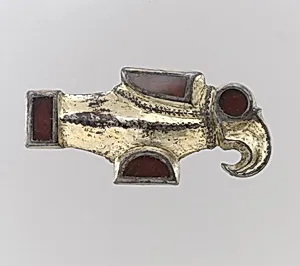
Medium
Silver-gilt, garnets, foil backings for garnets; iron spring
Dimensions
Overall: 1 1/4 x 9/16 x 5/16 in. (3.1 x 1.4 x 0.8 cm)
Classification
Metalwork-Silver
Culture
Frankish
Department
Medieval Art
Museum
Metropolitan Museum of Art, New York, NY
Credit
Gift of J. Pierpont Morgan, 1917
Accession Number
17.191.166
Rights
Public Domain
Tags
Art Historical Context
This delicate Bird-Shaped Brooch crafted by an unknown Frankish artisan between 500 and 600 AD, exemplifies the exquisite metalwork of the early Merovingian period. Measuring just 1¼ inches wide, this tiny treasure was likely a cloak fastener, or fibula, worn by elites to secure garments while signaling wealth and status. Its zoomorphic form—a stylized bird in flight—reflects the Migration Period's love for animal motifs, blending functionality with symbolic artistry in everyday adornment. Fashioned from silver-gilt for a luminous golden sheen, the brooch features inlaid garnets, a prized gemstone whose deep red glow was amplified by foil backings beneath—a clever cloisonné technique that made the stones appear to sparkle like fire. The iron spring mechanism ensured practicality, allowing it to pin fabrics securely. Such opulent materials were rare and labor-intensive, highlighting the advanced craftsmanship of Frankish workshops. Housed in the Metropolitan Museum of Art's Medieval Art collection (gift of J. Pierpont Morgan, 1917), this brooch offers a glimpse into a turbulent era of Frankish expansion across Europe. Birds in this context may evoke vigilance or the soul's journey, underscoring how personal ornaments doubled as cultural talismans for their wearers.