
Bird-Shaped Brooch
Unknown Artist
500–550
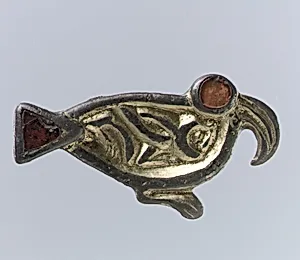
Medium
Silver-gilt, garnets; no spring/pin extant
Dimensions
Overall: 11/16 x 1 1/4 x 1/4 in. (1.7 x 3.1 x 0.7 cm)
Classification
Metalwork-Silver
Culture
Anglo-Saxon
Department
Medieval Art
Museum
Metropolitan Museum of Art, New York, NY
Credit
Gift of J. Pierpont Morgan, 1917
Accession Number
17.191.74
Rights
Public Domain
Tags
Art Historical Context
This exquisite Bird-Shaped Brooch, around 500–550 CE the Anglo-Saxon period, the masterful metalwork of early medieval England. Fashioned from silver-gilt—a technique where a thin layer of gold was applied over silver for a luxurious sheen—and adorned with vibrant garnets, the brooch measures just 11/16 x 1 1/4 inches. Originally functional as a garment fastener, its spring and pin are now lost, leaving us to admire its delicate form as a standalone treasure. In Anglo-Saxon culture, bird motifs like this one held symbolic power, often evoking protection, the soul's flight, or elite status among warriors and nobility. These zoomorphic brooches were popular accessories buried in high-status graves, reflecting influences from the Migration Period across Europe. The use of garnets, cut and set with precision, highlights advanced jewelry techniques that blended local craftsmanship with continental styles, showcasing the era's vibrant trade networks. A generous gift from J. Pierpont Morgan in 1917, this piece now graces the Medieval Art collection at The Metropolitan Museum of Art. It invites visitors to ponder the artistry of an anonymous maker, whose tiny creation bridges the gap between utility and symbolism in a turbulent time.