
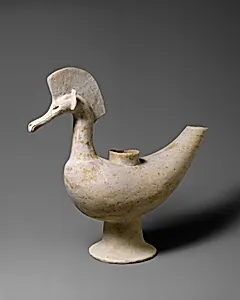
새 모양 토기 삼국|鳥形土器 三國|Bird-shaped vessel
Unknown Artist
3rd century
Medium
Earthenware
Dimensions
H. 12 7/8 in. (32.7 cm); W. 4 1/2 in. (11.4 cm); L. 13 7/8 in. (35.2 cm)
Classification
Ceramics
Culture & Period
Korea · Three Kingdoms period (57 B.C.–A.D. 676)
Department
Asian Art
Museum
Metropolitan Museum of Art, New York, NY
Credit
Purchase, Lila Acheson Wallace Gift, 1997
Accession Number
1997.34.1
Rights
Public Domain
Tags
Art Historical Context
This delightful bird-shaped earthenware vessel crafted in 3rd-century Korea during the Three Kingdoms period ( B.C.–A.D. 676), captures the ingenuity of ancient Korean potters. Standing about 13 inches long with a height of nearly 13 inches, its naturalistic form—evoking a perched bird with outstretched wings—demonstrates skillful hand-building and modeling techniques typical of early ceramic traditions. As an earthenware piece, it was likely low-fired, making it both functional and fragile, a testament to the era's reliance on clay for everyday and ritual vessels. The Three Kingdoms era, marked by the rival powers of Goguryeo, Baekje, and Silla, saw vibrant artistic expressions influenced by continental Asian styles and indigenous shamanism. Bird motifs, like this one, symbolized freedom, the soul, or celestial connections in Korean cosmology, often appearing on pottery used for pouring liquids in ceremonies or households. Though the artist remains unknown, such vessels highlight the period's technical prowess and cultural reverence for nature, bridging utility and symbolism. Today, this rare survivor graces the Metropolitan Museum of Art's Asian Art collection, acquired through the Lila Acheson Wallace Gift in 1997, offering a glimpse into Korea's dynamic prehistoric artistry.