
Birds
late 19th century
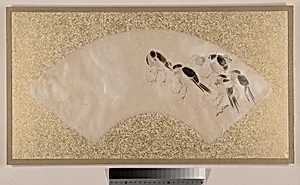
Medium
Fan painting mounted as album leaf; tempera on paper
Dimensions
Overall: 13 x 23 5/8 in. (33 x 60 cm) Image: 7 x 20 7/8 in. (17.8 x 53 cm)
Classification
Paintings
Culture & Period
Japan · Meiji period (1868–1912)
Department
Asian Art
Museum
Metropolitan Museum of Art, New York, NY
Credit
Purchase, Gifts, Bequests, and Funds from various donors, by exchange, 1952
Accession Number
52.160.6d
Rights
Public Domain
Tags
Art Historical Context
Shibata Zeshin's *Birds*, created in the late 19 century during Japan's Meiji period (186–1912), captures the grace of avian life in a delicate fan painting, later mounted as an album leaf. Zeshin (1807–1891), a virtuoso of Japanese lacquer art and painting, bridged traditional Edo-period aesthetics with Meiji-era innovations. Renowned for his *urushi-e* (lacquer paintings) that mimicked sumi ink's fluidity, he often drew from nature, using birds as symbols of harmony and seasonal change in East Asian art. Painted in tempera on paper—a medium allowing vibrant, opaque colors and fine detail—this work exemplifies Zeshin's technical mastery. Originally a folding fan, its intimate scale (image: 7 x 20⅞ in.) suited personal appreciation or gifts among elites. The Meiji era's cultural shifts, blending Japanese motifs with Western realism, shine through in Zeshin's precise, lifelike birds, perched or in flight against subtle grounds. Housed in the Metropolitan Museum of Art's Asian Art department, this piece highlights Zeshin's enduring legacy as Japan's last great lacquer master, whose works influenced global appreciation of *nihonga* (Japanese-style painting). Visitors will delight in its poetic blend of whimsy and refinement, evoking a bygone era's natural elegance.
About the Artist
Shibata Zeshin · 1807–1891
Japanese, 1807–1891