
Birth of the Virgin
c. 1784
Medium
Pen and brown ink with pen and brown wash, over traces of graphite, heightened with white gouache (discolored), on ivory laid paper
Dimensions
42 × 56 cm (16 9/16 × 22 1/16 in.)
Classification
pen and ink drawings
Department
Prints and Drawings
Museum
Art Institute of Chicago
Accession Number
194756
Rights
Public Domain
About this artwork
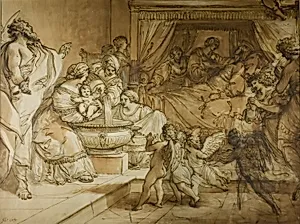
Cades divides his scene of the Virgin Mary’s birth into two symbolic halves. In the background at right, deep in shadow, Mary’s mother Saint Anne recuperates in bed. In the foreground at left, bathed in light, Saint Joachim gestures toward the infant Mary. Influenced by both ancient Roman sculptural reliefs and Italian Renaissance painting (particularly that of Raphael), the artist rendered the birth of the Virgin as if it were carved from time-stained marble. The drawing is characterized by st...
Art Historical Context
Giuseppe Cades, a Italian artist of the late 18th century, captures a tender moment in religious history with *Birth of the Virgin* (c. 1784). This preparatory drawing depicts the nativity of the Virgin Mary, a scene drawn from apocryphal texts celebrating her miraculous birth to the elderly Joachim and Anna. Working in Rome during the Neoclassical era, Cades blended classical clarity with emotional depth, reflecting the period's revival of antiquity and devotion to sacred narratives. Executed in pen and brown ink with brown wash over faint graphite traces, the work is heightened with white gouache on ivory laid paper, creating luminous effects and subtle tonal modeling. At 42 × 56 cm, this mixed-media technique—common among draftsmen of the time—allowed Cades to explore composition and light dynamically, likely as a study for a larger painting. The discolored gouache adds a patina of age, enhancing its historical allure. Housed in the Art Institute of Chicago's Prints and Drawings department, this piece exemplifies Cades's mastery in preparatory sketches, bridging the gap between studio practice and grand altarpieces. It invites visitors to appreciate the meticulous craft behind Baroque-Neoclassical transitions, offering a window into 18th-century Italian artistry.