
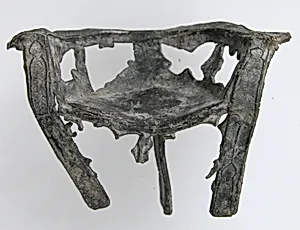
Bishop's Chair
Unknown Artist
early 15th century
Medium
Lead
Dimensions
Overall: 1 5/16 x 1 3/4 x 1 in. (3.3 x 4.4 x 2.5 cm)
Classification
Metalwork-Lead
Culture
Austrian
Department
Medieval Art
Museum
Metropolitan Museum of Art, New York, NY
Credit
Gift of Ruth Blumka, 1974
Accession Number
1974.187
Rights
Public Domain
Art Historical Context
Nestled in the Metropolitan Museum of Art's Medieval collection, this delicate "Bishop's Chair" a rare survivor from early 15th-century Austria Crafted by an unknown from lead—a humble yet durable medium—this miniature metalwork measures just 1 5/16 x 1 3/4 x 1 inches, small enough to fit in the palm of your hand. Likely a votive offering or pilgrim's souvenir, it evokes the grand cathedrae of Gothic cathedrals, symbolizing authority and spiritual seat of a bishop. In medieval Europe, such lead models were prized for their portability and affordability, allowing devotees to carry a piece of sacred architecture on journeys to holy sites. Austrian metalworkers excelled in casting these intricate forms, often using simple molds to replicate architectural details with surprising fidelity. This example, gifted to the Met in 1974 by Ruth Blumka, highlights the region's vibrant ecclesiastical art during the late Middle Ages, a time when the Church's influence peaked amid the transition from Gothic to Renaissance styles. Though modest in scale, the chair's preservation offers a window into everyday piety and craftsmanship, reminding us how faith was worn close to the heart. Pause to admire its quiet elegance—a testament to medieval devotion in miniature.