
Bit Boss
Unknown Artist
first half 17th century
Medium
Copper alloy, gold
Dimensions
Diam. 3 1/2 in. (8.9 cm); Wt. 3.5 oz. (99 g)
Classification
Equestrian Equipment-Bits
Culture
probably Netherlandish
Department
Arms and Armor
Museum
Metropolitan Museum of Art, New York, NY
Credit
Gift of Stephen V. Grancsay, 1942
Accession Number
42.50.182
Rights
Public Domain
Art Historical Context
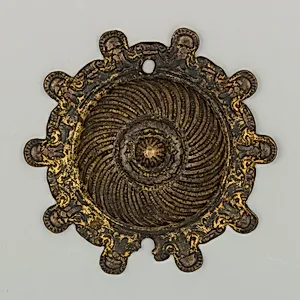
Behold the *Bit Boss*, a finely crafted piece of equestrian equipment from the first half of the17th century, likely from the Netherlands during its Golden Age. This small yet elegant object, measuring just 3 1/2 inches in diameter and weighing 3.5 ounces, served as a decorative boss on a horse's bit—a crucial component of bridle gear used by cavalry riders and elite horsemen. Displayed in the Metropolitan Museum Art's Arms and Armor, it exemplifies the exquisite metalwork of the period, gifted by collector Stephen V. Grancsay in 1942. Crafted from copper alloy adorned with gold, the bit boss highlights the technical prowess of Netherlandish artisans, who combined durability with opulent embellishment. The gold likely served as gilding or inlay, transforming a functional item into a status symbol for wealthy officers or nobility. In an era of intense military innovation and colonial expansion, such gear underscored the importance of the mounted soldier, blending utility with artistry in the Baroque spirit of grandeur. This artifact offers a glimpse into 17th-century equestrian culture, where horse bits were not mere tools but expressions of power and refinement. Its survival speaks to the enduring legacy of Netherlandish craftsmanship, inviting us to appreciate the unsung details of historical horsemanship.