
Black Cat and Narcissus
19th century
Medium
Hanging scroll; ink and color on paper
Dimensions
36 7/8 x 14 1/2 in. (93.7 x 36.8 cm)
Classification
Paintings
Culture & Period
China · Qing dynasty (1644–1911)
Department
Asian Art
Museum
Metropolitan Museum of Art, New York, NY
Credit
Rogers Fund, 1956
Accession Number
56.129.3
Rights
Public Domain
Tags
About this artwork
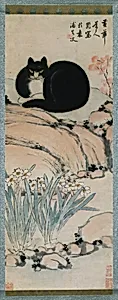
This hanging scroll presents a black cat rendered in heavy black ink, positioned alongside delicate narcissus flowers depicted in soft pink and powder blue. Zhu Ling created this work in the nineteenth century during the Qing dynasty, demonstrating the Chinese artistic tradition of pairing animals with plants to create harmonious compositions imbued with symbolic meaning. The cat appears as the focal point of the nearly three-foot-tall vertical composition, its dark form creating dramatic contra...
Art Historical Context
In the elegant tradition of Qing dynasty painting, Zhu Ling's *Black Cat and Narcissus (19th century)ivates with its harmonious blend of animal and floral motifs. This nearly three-foot-tall hanging scroll, executed in ink and color on (36 7/8 x 14 1/2 in.), features a boldly rendered black cat in heavy ink as the dramatic focal point, contrasting sharply against delicate narcissus flowers in soft pink powder blue. The refined brushwork exemplifies Chinese artists' mastery of balance juxtaposing strength and delicacy, darkness and light. Active around 1820–1850 during the late Qing era (1644–1911), Zhu Ling worked amid cultural shifts, including growing Western influences, yet upheld time-honored techniques. Hanging scrolls like this were designed for display during special occasions, unrolled to reveal symbolic narratives that invited contemplation. Symbolically rich, the cat evokes domesticity and good fortune, while narcissus—blooming at lunar New Year—heralds prosperity. Their auspicious pairing reflects Chinese values of harmony and renewal. Acquired by The Metropolitan Museum of Art in 1956 via the Rogers Fund, this work invites visitors to appreciate the enduring poetry of nature in art.