
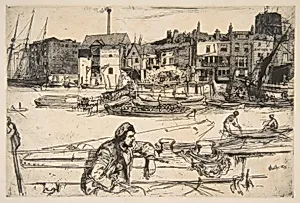
Black Lion Wharf
Medium
Etching; fourth state of four (Glasgow)
Dimensions
Sheet: 11 7/16 × 16 1/8 in. (29 × 41 cm) Plate: 6 × 9 in. (15.2 × 22.8 cm)
Classification
Prints
Department
Drawings and Prints
Museum
Metropolitan Museum of Art, New York, NY
Credit
Gift of Susan Dwight Bliss, 1967
Accession Number
67.630.59
Rights
Public Domain
Tags
Art Historical Context
James McNeill Whistler's *Black Lion Wharf* (1859) captures the gritty vitality of Victorian London's Thames waterfront in a masterful etching. This fourth and final state from the Glasgow catalog raisonné depicts a bustling wharf scene alive with buildings, men at work, and moored boats—evoking industrial hum of 19th-century trade along the river. Whistler, an American expatriate in London, drew inspiration from the everyday realism of urban life, blending precise observation with emerging tonal subtlety that foreshadowed his later Aestheticist pursuits. Printed from a modest 6 × 9-inch plate on a larger sheet, the etching showcases Whistler's innovative printmaking technique. He meticulously reworked plates across states, refining lines and textures to build depth and atmosphere through aquatint-like effects and subtle biting of the metal. This process highlights etching's intimacy as a medium, allowing artists to produce multiples while achieving painterly nuance—revolutionary for the time. Housed in the Metropolitan Museum of Art's Drawings and Prints department (gift of Susan Dwight Bliss, 1967), *Black Lion Wharf* exemplifies Whistler's early mastery of the Thames etchings series, bridging Realism and modernism. It's a window into a vanishing riverside world, inviting visitors to ponder the poetry in the mundane.
About the Artist
James McNeill Whistler · 1834–1903
James Abbott McNeill Whistler (1834-1903) was an American-born painter and printmaker who became a leading figure in the Aesthetic Movement and pioneer of Tonalism and Japonisme. He revolutionized art by championing "art for art's sake" and treating paintings as visual equivalents of musical compositions, titling works as "arrangements," "harmonies," and "nocturnes" to emphasize formal qualities o...