
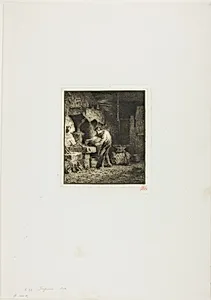
Blacksmith Facing Left
Medium
Etching, engraving and roulette on cream China paper laid down on ivory wove paper
Dimensions
Image: 13.3 × 11.6 cm (5 1/4 × 4 5/8 in.); Chine: 14.3 × 12.4 cm (5 11/16 × 4 15/16 in.); Plate: 15.6 × 13.4 cm (6 3/16 × 5 5/16 in.); Sheet: 42.4 × 29.9 cm (16 3/4 × 11 13/16 in.)
Classification
etching
Department
Prints and Drawings
Museum
Art Institute of Chicago
Accession Number
45671
Rights
Public Domain
Art Historical Context
In the mid-19th century, French artist Charles Émile Jacque captured the grit and dignity of rural life through his masterful prints. *Blacksmith Facing Left* (1850), from the Art Institute of Chicago's Prints and Drawings collection, depicts a solitary blacksmith in profile, evoking the hardworking figures of the French countryside. Jacque, a key member of the Barbizon School, drew inspiration from everyday laborers and pastoral scenes, bridging Romanticism's emotional depth with emerging Realism. This etching reflects the era's fascination with pre-industrial trades amid France's rapid modernization. Jacque's technical prowess shines in his use of etching, engraving, and roulette on delicate cream China paper, laid down on sturdy ivory wove paper. Etching allows fluid, expressive lines etched by acid, while engraving's precise burin cuts add sharp definition. The roulette—a toothed wheel—creates velvety textures, enhancing the blacksmith's muscular form and the play of light on metal tools. These layered techniques on thin China paper yield intricate details in the modest 13.3 × 11.6 cm image, making it a gem for collectors. This intimate print not only showcases Jacque's printmaking innovation but also immortalizes vanishing rural crafts, inviting us to appreciate the artistry in ordinary labor. A testament to 19th-century graphic mastery, it reminds visitors of art's power to honor the unsung heroes of history.