
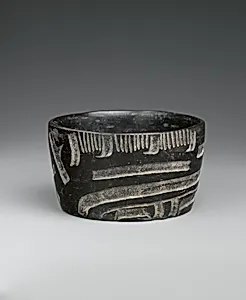
Blackware Bowl
Unknown Artist
12th–8th century BCE
Medium
Ceramic
Dimensions
H. 2 3/8 x Diam. 4 1/8 in. (6 x 10.5 cm)
Classification
Ceramics-Containers
Culture
Olmec
Department
Arts of Africa, Oceania, and the Americas
Museum
Metropolitan Museum of Art, New York, NY
Credit
Gift of Albert J. Grant and Monique Grant Joint Revocable Trust, 2014
Accession Number
2014.244.9
Rights
Public Domain
Art Historical Context
Behold the **Blackware Bowl**, a delicate ceramic vessel from the Olmec culture, crafted between the 12th and 8th centuries BCE. As one of Mesoamerica's earliest civilizations—often called the "mother culture" of later societies like the Maya and Aztec—the Olmec thrived in the Gulf Coast region of modern-day Mexico. This small bowl (H. 2 3/8 x Diam. 4 1/8 in.) exemplifies their pioneering pottery traditions, produced long before the Common Era. Olmec blackware, like this piece, achieved its sleek, lustrous surface through meticulous hand-building and burnishing techniques, followed by controlled firing in a low-oxygen environment to produce the signature glossy black hue. Simple yet elegantly proportioned, such containers served practical purposes—holding food, liquids, or offerings—while hinting at the Olmec's advanced craftsmanship amid their monumental stone sculptures and jade carvings. Housed in the Metropolitan Museum of Art's Department of the Arts of Africa, Oceania, and the Americas (gift of Albert J. Grant and Monique Grant Joint Revocable Trust, 2014), this bowl offers a tangible link to Olmec daily life and ritual, inviting us to ponder the ingenuity of these ancient innovators.