
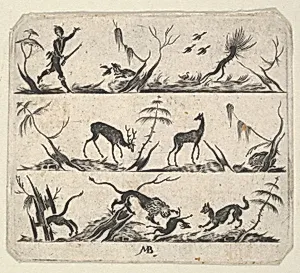
Blackwork Design for Goldsmithwork with a Hunter and Animals
1612
Medium
Engraving and blackwork
Dimensions
Sheet: 1 7/8 × 2 1/8 in. (4.7 × 5.4 cm)
Classification
Prints|Ornament & Architecture
Department
Drawings and Prints
Museum
Metropolitan Museum of Art, New York, NY
Credit
Harris Brisbane Dick Fund, 1931
Accession Number
31.32.45
Rights
Public Domain
Tags
Art Historical Context
This delicate engraving by Mathais Beitler, created in 1612, served as a practical design model for goldsmiths. Titled *Blackwork Design for Goldsmithwork with a Hunter and Animals*, the tiny sheet—just under two inches across—features a hunter amid deer and other creatures rendered in precise blackwork, a technique that combines fine engraving with dense, ink-rich areas to mimic the look of metalwork or niello. Such prints were essential pattern books in the early seventeenth century, allowing artisans to transfer ornamental motifs onto jewelry, vessels, and decorative objects. The composition reflects the period’s fascination with hunting scenes, which symbolized nobility, nature, and the chase. Beitler’s compact arrangement packs dynamic movement into a miniature format, demonstrating the high level of detail possible in prints classified as ornament and architecture. Acquired by the Metropolitan Museum through the Harris Brisbane Dick Fund in 1931, the work offers modern viewers a glimpse into how printed designs bridged the worlds of graphic art and luxury metalwork during the late Renaissance and early Baroque eras.