
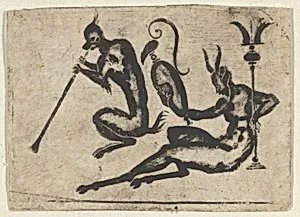
Blackwork Design for Goldsmithwork with Satyr and Monkey
ca. 1582–1616
Medium
Engraving and blackwork
Dimensions
Sheet: 1 1/16 × 1 1/2 in. (2.7 × 3.8 cm)
Classification
Prints|Ornament & Architecture
Department
Drawings and Prints
Museum
Metropolitan Museum of Art, New York, NY
Credit
Harris Brisbane Dick Fund, 1924
Accession Number
24.69.9
Rights
Public Domain
Tags
Art Historical Context
In the late 16th century, engraver Mathais Beit created this exquisite *Blackwork Design for Goldsmith with Satyr and Monkey (ca. 15821616), a diminutive engraving measuring just 1 1/16 × 1 1/2 inches. Produced as a pattern for goldsmiths, it exemplifies the Renaissance tradition of printed ornament designs, which allowed artisans across Europe to replicate intricate motifs in precious metals for jewelry, vessels, and decorative objects. Housed in the Metropolitan Museum of Art's Drawings and Prints department, this piece reflects the era's fascination with detailed, transferable craftsmanship. The composition features a playful satyr—a mythical half-human, half-goat figure symbolizing revelry—and a mischievous monkey, likely interacting with musical instruments, evoking the grotesque style popular in Northern European art. Beit's innovative use of engraving combined with blackwork—a dense cross-hatching technique—produces rich tonal contrasts and shadowy depths on the tiny sheet, mimicking the luster and texture of polished gold. This precision made it ideal for translating into three-dimensional metalwork. Such designs bridged art and industry, democratizing elaborate motifs inspired by antiquity and nature. Visitors will appreciate how this unassuming print captures the whimsical spirit of Renaissance ornamentation, blending fantasy with functional beauty.