
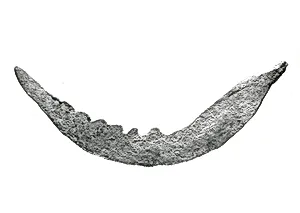
Blade
Unknown Artist
ca. late 3rd–early 2nd millennium BCE
Medium
Copper alloy
Dimensions
7.87 in. (19.99 cm)
Classification
Metalwork-Implements
Culture & Period
Bactria-Margiana Archaeological Complex · Bronze Age
Department
Ancient Near Eastern Art
Museum
Metropolitan Museum of Art, New York, NY
Credit
Gift of Steven D. Robinson, 1981
Accession Number
1981.448.20
Rights
Public Domain
Art Historical Context
This exquisite copper alloy blade, dating to the late 3rd–early 2nd millennium BCE, hails from the Bactria-Margiana Complex (BMAC)—a enigmatic Bronze Age civilization flourishing in the ancient river oases of modern-day Turkmenistan, Uzbekistan, northern Afghanistan. Measuring nearly 8 inches (19.99 cm), this implement exemplifies early metallurgical prowess, crafted from a durable copper alloy that marked the transition from the Copper Age to full Bronze Age technologies around 2300–1700 BCE. In the BMAC, urban centers like Gonur Tepe buzzed with sophisticated trade networks linking Mesopotamia, the Indus Valley, and Central Asia. Blades like this one, classified as metalwork implements, likely served practical purposes—perhaps as tools for cutting, harvesting, or even weapons in daily life or ritual. The anonymous artisan's skill in casting and hammering the alloy highlights a cultural emphasis on functionality fused with emerging aesthetic refinement, offering a window into a society known for its fortified settlements, intricate seals, and chlorite vessels. A generous gift to the Metropolitan Museum of Art from Steven D. Robinson in 1981, this blade invites us to ponder the ingenuity of BMAC peoples, whose innovations influenced broader Eurasian exchanges long before written records. (198 words)