
Blade and Mounting for a Sword (Katana)
blade, dated 1839; mounting, 19th century
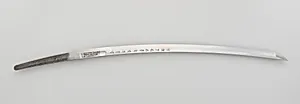
Medium
Steel, wood, lacquer, rayskin (samé), silk, iron, copper-gold alloy (shakudō), copper, gold, silver
Dimensions
L. 39 1/4 in. (99.8 cm); L. of blade 36 15/16 in. (93.8 cm); L. of cutting edge 28 5/8 in. (72.7 cm); D. of curvature 1 3/16 in. (3 cm)
Classification
Swords
Culture
Japanese
Department
Arms and Armor
Museum
Metropolitan Museum of Art, New York, NY
Credit
Gift of Brayton Ives and W. T. Walters, 1891
Accession Number
91.2.56
Rights
Public Domain
Art Historical Context
This exquisite *Blade and Mounting for a SwordKatana)*, forged by the renowned Japanese swordsmith Naotane in 1839 with 19th-century fittings attributed to artisans like Taikei, Yukinaka, andjō Yoshitane, exemplifies the pinnacle of Edo-period craftsmanship. Measuring nearly 40 inches overall, with a sharply curved 28⅝-inch cutting edge, this katana was designed as both a deadly weapon and a work of art, reflecting the samurai class's dual emphasis on martial prowess and aesthetic refinement. The blade's high-carbon steel, meticulously folded and tempered to produce a razor-sharp edge and visible hamon (temper line), showcases advanced metallurgical techniques honed over centuries. The mounting features a lacquered wooden scabbard, rayskin (samé) handle for superior grip, and ornate fittings in shakudō (copper-gold alloy), gold, silver, and iron—often decorated with intricate motifs symbolizing status and power. These elements highlight the katana's role beyond combat, as a status symbol carried by nobility. Housed in the Metropolitan Museum of Art's Arms and Armor Department since its 1891 gift from Brayton Ives and W. T. Walters, this katana offers a window into Japan's feudal past, where sword-making blended functionality, spirituality, and artistry in a tradition dating back to the Kamakura period. A true marvel for visitors!
About the Artist
Naotane Taikei|Yukinaka|Honjō Yoshitane (Japanese|Japanese|Japanese) · 1778 |1801 |1801 –1857 |1900 |1900
Japanese, Yamagata 1778–1857 Edo|Japanese, Edo period, 19th century|Japanese, Hagi, active 19th century