
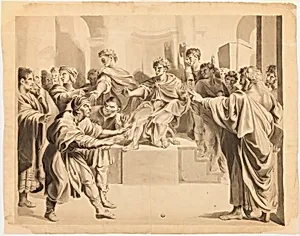
Blinding of Elymas
c. 1807
Medium
Brush and black and gray wash, over graphite, on cream wove paper
Dimensions
51.6 × 65.9 cm (20 3/8 × 26 in.)
Classification
wash
Department
Prints and Drawings
Museum
Art Institute of Chicago
Accession Number
109149
Rights
Public Domain
Art Historical Context
In the early 19th century, John Constable the celebrated English Romantic artist best known for his luminous landscapes of the Suffolk countryside, explored biblical narratives as a young painter honing his skills. *Blinding of Elymas* (c. 1807) depicts a dramatic moment from the New Testament Book of Acts (13:6–12), where the Paul strikes the sorcerermas blind for opposing his preaching to the Roman proconsul Sergius Paulus. This large-scale drawing, housed in the Art Institute of Chicago's Prints and Drawings department, reveals Constable's versatility beyond his iconic oil paintings, showcasing his early ambitions in history painting—a genre prized by the Royal Academy, where he studied. Crafted with brush and black and gray wash over graphite on cream wove paper (51.6 × 65.9 cm), the work exemplifies the wash technique's expressive power. Diluted inks create subtle tonal gradations and atmospheric depth, mimicking the fluidity of watercolor while allowing precise control over light and shadow. Graphite underdrawing provides a structural foundation, highlighting Constable's meticulous preparatory process. As a rare surviving example of Constable's figural studies from his formative years, this piece offers insight into his artistic evolution. Before mastering en plein air landscapes, he grappled with dynamic compositions and human drama, bridging neoclassical ideals with emerging Romantic sensibilities. Visitors will appreciate its technical finesse and narrative intensity, a testament to the artist's enduring curiosity.
About the Artist
John Constable · 1776–1837
John Constable (1776-1837) was an English landscape painter whose naturalistic depictions of the Suffolk countryside revolutionized landscape painting and established him, alongside J.M.W. Turner, as one of England's greatest artists. His work pioneered the direct observation of nature that would later influence the French Barbizon school and, ultimately, Impressionism. Born in East Bergholt, Suf...