
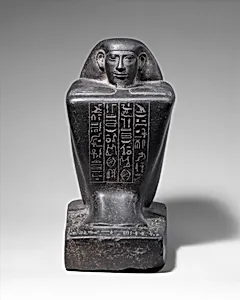
Block Statue of a Prophet of Montu and Scribe Djedkhonsuefankh, son of Khonsumes and Taat
Unknown Artist
690–610 B.C.
Medium
Gabbro
Dimensions
h. 30.7 cm (12 1/16 in)
Classification
Block statue, Djedkhonsuefankh
Period
Late Period, Kushite–Saite
Department
Egyptian Art
Museum
Metropolitan Museum of Art, New York, NY
Credit
Rogers Fund, 1907
Accession Number
07.228.27
Rights
Public Domain
Tags
Art Historical Context
This compact sculpture presents a male figure seated with knees drawn up to the chest, his body reduced to a smooth, rectangular block of dark gabbro. Only the head, shoulders, and base emerge from the simplified form, while finely incised hieroglyphs cover the front surface in vertical columns. The face is rendered with calm, symmetrical features—large eyes, a gentle mouth, and a short wig or headdress—giving the figure a composed, dignified presence against a neutral background. Carved during Egypt’s Late Period, Dynasty 25–26, the work belongs to the long tradition of block statues favored by temple officials and scribes. Such figures allowed inscriptions naming the owner, his titles, and his family to be displayed prominently, ensuring the individual’s identity and prayers would endure. Here the hieroglyphs identify the subject as Djedkhonsuefankh, a prophet of the god Montu and a scribe, son of Khonsumes and Taat. The choice of hard, dark stone and the restrained modeling reflect both the technical skill of the unknown artist and the period’s emphasis on enduring temple dedications. Visitors can appreciate how the sculpture’s compact shape and clear inscriptions once served a devotional purpose within a sacred setting.