
Bloemen
1860 - 1912
Medium
oil on panel
Dimensions
4; 48; 91
Rights
Public Domain
About this artwork
Legaat van de heer A. van Wezel, Amsterdam
Art Historical Context
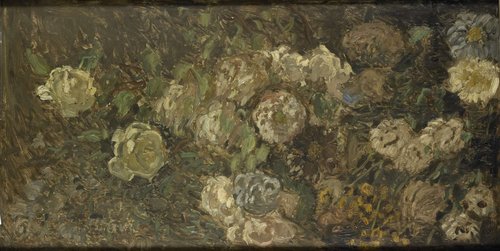
Claude Monet's *Bloemen* (Flowers), dating from somewhere within his prolific career span of 1860–1912, captures the artist's enduring fascination with nature's fleeting beauty. As a cornerstone of Impressionism, Monet revolutionized painting by emphasizing light, color, and everyday subjects over meticulous detail. This oil on panel, measuring 91 × 48 cm, stands out for its intimate vertical format, ideal for a vibrant floral bouquet that likely draws from the lush gardens of his later years at Giverny. The choice of panel as a support—less common for Monet than canvas—suggests a portable study or personal sketch, allowing for quick, spontaneous brushwork to convey the impression of blooming petals and soft shadows. Impressionist techniques shine here: loose, dappled strokes evoke the play of sunlight on flowers, blurring boundaries between object and atmosphere. Housed in Amsterdam's Rijksmuseum, *Bloemen* reflects the museum's eclectic collection bridging Dutch masters with international modernists. A generous bequest from Amsterdam collector A. van Wezel in the 20th century brought this gem to public view, underscoring its cultural journey from private treasure to shared heritage. Visitors will delight in its joyful vibrancy, a testament to Monet's lifelong pursuit of nature's ephemeral magic.
About the Artist
Claude Monet · 1840–1926
Claude Monet, born Oscar-Claude Monet on November 14, 1840, in Paris and raised in Le Havre, Normandy, began his artistic journey as a successful teenage caricaturist. His formal training started at the Le Havre secondary school of the arts in 1851, where he received his first drawing lessons from Jacques-François Ochard. Around 1858, he met Eugène Boudin, who became his pivotal mentor, introducin...