
Blue-Painted Jar Fragment from Malqata
Unknown Artist
ca. 1390–1352 B.C.
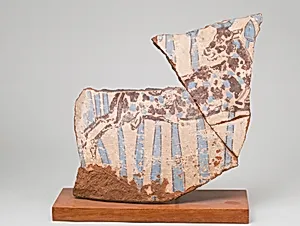
Medium
Pottery, slip, paint
Dimensions
H. 25.7 × W. 25 cm (10 1/8 × 9 13/16 in.)
Classification
Blue-painted jar fragment, bull leaping
Period
New Kingdom
Department
Egyptian Art
Museum
Metropolitan Museum of Art, New York, NY
Credit
Rogers Fund, 1912
Accession Number
12.180.33
Rights
Public Domain
Tags
Art Historical Context
This captivating fragment of a blue-painted jarails from Malqata, the sprawling palace complex of Pharaoh Amenhotep III in Egypt's New Kingdom (Dynasty 18, ca. 1390–1352 B.C.). Discovered amid the opulent remains of this royal residence on the west bank of Thebes, it offers a glimpse into the luxurious daily life of Egypt's golden age. Measuring about 10 inches high and wide, the shard preserves vibrant blue decoration on pottery, including motifs of cows—powerful symbols of fertility, nourishment, and the goddess Hath in Egyptian culture. Crafted with slip (a liquid clay mixture) and applied paint, the technique highlights the Egyptians' mastery of ceramics during this prosperous era. Blue pigment, evoking the Nile's life-giving waters and the precious stone lapis lazuli, was reserved for high-status objects, transforming ordinary pottery into artistic treasures. Such painted vessels were likely used for storage or ritual purposes in the palace, blending utility with beauty. Today, this piece graces the Egyptian Art collection at The Metropolitan Museum of Art, acquired through the Rogers Fund in 1912. It reminds us how even a humble fragment can whisper tales of imperial splendor and artistic innovation from over 3,300 years ago.