
Blue Ridge Mountains
c. 1898
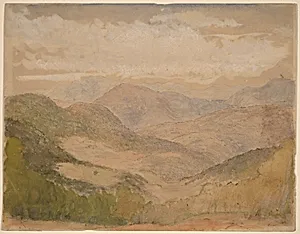
Medium
watercolor and gouache with pen and brown ink on wove paper
Dimensions
sheet: 17.9 × 23 cm (7 1/16 × 9 1/16 in.)
Classification
Drawing
Department
CG-W
Museum
National Gallery of Art, Washington, D.C.
Credit
Gift of William B. O'Neal
Accession Number
1995.52.200
Rights
Public Domain
Art Historical Context
Visitors to the National Gallery of Art are delighted *Blue Ridge Mountains*, a landscape sketch created around 1898 by Stanford White, the American architect of the Gilded Age. Best known for his Beaux-Arts designs with partner firm McKim, Mead White—including grand structures like the Washington Square Arch—White also pursued fine drawing, revealing his keen eye for form and atmosphere. This intimate work on wove paper17.9 × 23 cm) captures the rolling vistas of the Appalachian Blue Ridge, evoking the era's growing fascination with America's natural wonders amid rapid urbanization. Rendered in watercolor and gouache with pen and brown ink, the piece showcases White's masterful blending of translucent washes for misty skies and distant peaks, contrasted by the precise, calligraphic lines of ink that define ridges and foliage. Gouache's opacity adds luminous depth to the scene, a technique favored for its versatility in studies. Classified as a drawing, it reflects architects' tradition of on-site sketching to train observation skills, bridging professional practice and personal expression. A generous gift from William B. O'Neal, this gem in the museum's CG-W department highlights White's lesser-known artistic talents, offering a serene counterpoint to his monumental buildings. It invites us to appreciate how even architects like White found inspiration in nature's quiet majesty.