
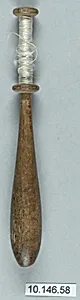
Bobbin
Unknown Artist
18th century
Medium
Wood
Classification
Textiles-Methods and Materials
Culture
Flemish
Department
European Sculpture and Decorative Arts
Museum
Metropolitan Museum of Art, New York, NY
Credit
Gift of Miss Julia Chester Wells, 1910
Accession Number
10.146.58
Rights
Public Domain
Tags
Art Historical Context
Nestled in the Metropolitan Museum of Art's European Sculpture and Decorative collection, this unassuming wooden bobbin from 18th-century Flanders reveals the intricate world of textile craftsmanship. Crafted from wood—a practical and lightweight medium ideal for handheld tools—this bobbin served as an essential instrument in bobbin lacemaking, where threads are wound around it and twisted into delicate patterns on a pillow or cushion. Its simple form belies the precision required in its creation, likely turned on a lathe to achieve a smooth, ergonomic shape for hours of skilled labor. Flemish lacemaking reached its zenith in the 18th century, with regions like Brussels and Mechelen producing some of Europe's finest bobbin laces, prized by royalty and exported worldwide. This artifact, classified under Textiles-Methods and Materials, highlights the cultural importance of these tools in preserving a labor-intensive tradition that blended artistry with industry. Bobbins like this one were often personalized or regionally stylized, reflecting the weaver's pride in their trade. Generously gifted to the Met in 1910 by Miss Julia Chester Wells, this bobbin invites visitors to appreciate the unsung heroes of decorative arts: the tools that wove beauty from thread. Though its anonymous maker remains unknown, it stands as a tangible link to Flanders' rich heritage of innovation and finesse.