
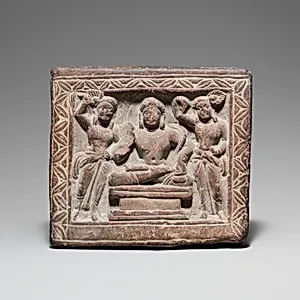
Bodhisattva and Attendants
Unknown Artist
2nd–3rd century
Medium
Red stone
Dimensions
H. 7 in. (17.8 cm); W. 7 1/2 in. (19.1 cm); D. 1 5/8 in. (4.1 cm)
Classification
Sculpture
Culture
India (Uttar Pradesh, Mathura)
Department
Asian Art
Museum
Metropolitan Museum of Art, New York, NY
Credit
Rogers Fund, 1929
Accession Number
29.50
Rights
Public Domain
Tags
Art Historical Context
This exquisite red stone relief sculpture, *Bodhisattva and Att*, hails from Mathura in Uttar Pradesh, India, during Kushan period (2nd–3rd century). Carved from the region's signature reddish sandstone, it measures a compact 7 inches high, suggesting it may have adorned a stupa, temple rail, or personal devotional shrine. At its center stands a serene Bodhisattva— a compassionate enlightened being in Buddhist tradition—flanked by smaller attendant figures, their graceful forms exuding spiritual harmony. Mathura was a thriving artistic hub under the Kushan Empire, which fused Indian, Greco-Roman, and Central Asian influences, birthing one of early Buddhism's most vibrant sculptural schools. This piece exemplifies the school's hallmarks: fluid drapery on robes, idealized youthful features, and a sense of divine benevolence. The low-relief technique, with its shallow 1⅝-inch depth, allowed artisans to achieve intricate details while conserving material, making such works accessible for widespread worship. As a testament to Mahayana Buddhism's rise, the sculpture invites viewers to contemplate the Bodhisattva's vow to aid all beings toward enlightenment. Acquired through the Rogers Fund in 1929, it now graces the Metropolitan Museum of Art's Asian Art collection, bridging ancient devotion with modern appreciation.