
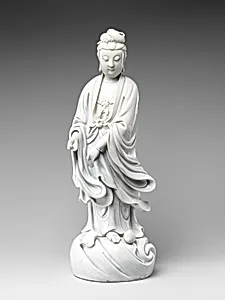
明末清初 德化窯白瓷觀音立像|Bodhisattva Guanyin
Unknown Artist
17th century
Medium
Porcelain with ivory glaze (Dehua ware)
Dimensions
H. 16 1/4 in. (41.3 cm)
Classification
Ceramics
Culture & Period
China · late Ming (1368–1644)–early Qing (1644–1911) dynasty
Department
Asian Art
Museum
Metropolitan Museum of Art, New York, NY
Credit
Bequest of Mary Clark Thompson, 1923
Accession Number
24.80.155
Rights
Public Domain
Tags
About this artwork
This porcelain figure of Guanyin, the Bodhisattva of Compassion, exemplifies Dehua ware (known in the West as blanc de chine) at its most spiritually evocative and technically accomplished. Created during the late Ming (1368-1644) or early Qing (1644-1911) dynasty, this 16 1/4-inch figure demonstrates the Dehua kilns' mastery of white porcelain with ivory-toned glaze—a material prized for its smooth, jade-like surface and ability to capture subtle modeling and drapery details. Guanyin, original...
Art Historical Context
This exquisite porcelain figure of Guanyin, the Bodhisattva of Compassion stands 16¼ inches tall and exemplifies the pinnacle of Dehua ware—known in the West as de chine—from China's Fujian province kilns. Crafted in the late Ming (1368–1644) or early Qing1644–1911) dynasty during the 17th century, its smooth ivory-toned glaze and jade-like surface capture intricate details of flowing robes and subtle modeling, creating a spiritually evocative glow that seems to emanate inner light. Guanyin, originally the male Avalokitesh from Indian Buddhism, evolved in Chinese tradition into a feminine deity symbolizing maternal mercy and protection for mothers and children. As the most beloved subject for Dehua sculptors, including masters like He Chaozong (active 1573–1620), these figures were produced in kilns active since the Song dynasty, reaching fame in the Ming-Qing era through exports to Europe, where they inspired imitations by manufactories like Meissen. The deep carving and pale yellow-tinged glaze here suggest late Ming origins, showcasing advanced clay formulations and firing techniques. A generous bequest from Mary Clark Thompson in 1923 brought this devotional masterpiece to the Metropolitan Museum of Art's Asian Art collection, where it stands as both a ceramic triumph and a testament to Buddhism's enduring cultural resonance in China.